Visigoo | AI Visibility Tracker SaaS


Required: your own third-party accounts (read before buying)
The purchase price covers the source code only. No third-party account, key, credit or service is included. The features below cannot work until you register your own account with each company, accept its terms, enter your own keys and pay its fees yourself.
- AI answer providers: hard requirement for real data. Visigoo measures what AI assistants answer, so every answer it collects is a paid API request made with your own key: OpenAI (ChatGPT answers), Google Gemini, Anthropic (Claude answers), Perplexity, xAI (Grok), DeepSeek and Mistral (Le Chat), or DataForSEO for the answers shown in the ChatGPT and Gemini apps and for Google AI Overviews and AI Mode. Optionally, Bright Data or SerpApi, or an AI gateway (OpenRouter, Vercel AI Gateway, Cloudflare AI Gateway, Requesty or your own LiteLLM proxy) on your own account. On plans you allow it, a customer can enter their own AI keys and pay their provider directly. Any engine you do not offer can be switched off. Each provider bills you per request, under its own terms and prices. Without a key, an engine collects nothing on a live site: the demo data source only runs on a local install or a site in demo mode. No AI credits are included.
- A payment provider: required to charge your customers. Stripe, Paddle, Polar, Creem, Dodo Payments or Lemon Squeezy, on your own approved seller account. No payment keys, product ids or webhook secrets of ours ship anywhere in the package.
- Email delivery: required. Sign-up verification, password resets, invitations and security alerts are sent from your own mail account (SMTP, or an API provider such as Postmark, Amazon SES, Resend, SendGrid, Brevo or Mailtrap).
- Hosting: required. PHP 8.4 and MySQL hosting with one cron entry. A queue worker, or Upstash QStash on shared hosting where no process can stay running.
- Also on your own accounts, all optional: Google and GitHub sign-in, Cloudflare Turnstile or Google reCAPTCHA, S3-compatible storage and CDN, Upstash QStash, Sentry error reporting, an AI provider for content drafts, briefs, fact checks, ad copy and support-reply drafts, a Google Ads API developer token and a Meta app (so your customers can send ads to their own ad accounts). Each is listed with its cost below.
- Your customers’ own accounts: publishing sends drafts to the customer’s own WordPress, Ghost, Webflow or Shopify site or webhook, and ads go to the customer’s own Google Ads, OpenAI Ads or Meta ad account, always as paused campaigns. Visigoo never spends an ad budget.
IMPORTANT: ongoing monthly costs
Your customers pay you; you pay the AI providers for every answer. One answer with web search typically costs about US$0.005 to US$0.03 depending on the provider, the model and the length of the answer. How many answers a brand uses is simple arithmetic, and the brand form shows it as the customer types:
answers per month = prompts × engines × runs per prompt × sweeps per week × 52 / 12
Worked example: 20 prompts × 4 engines × 3 runs × 2 sweeps a week ≈ 2,080 answers a month. At US$0.01 per answer that is about US$21 a month in provider costs for one brand.
What protects you:
- Every plan has a monthly answer allowance. An answer is claimed from it before the provider is called, so a workspace can never spend past its plan.
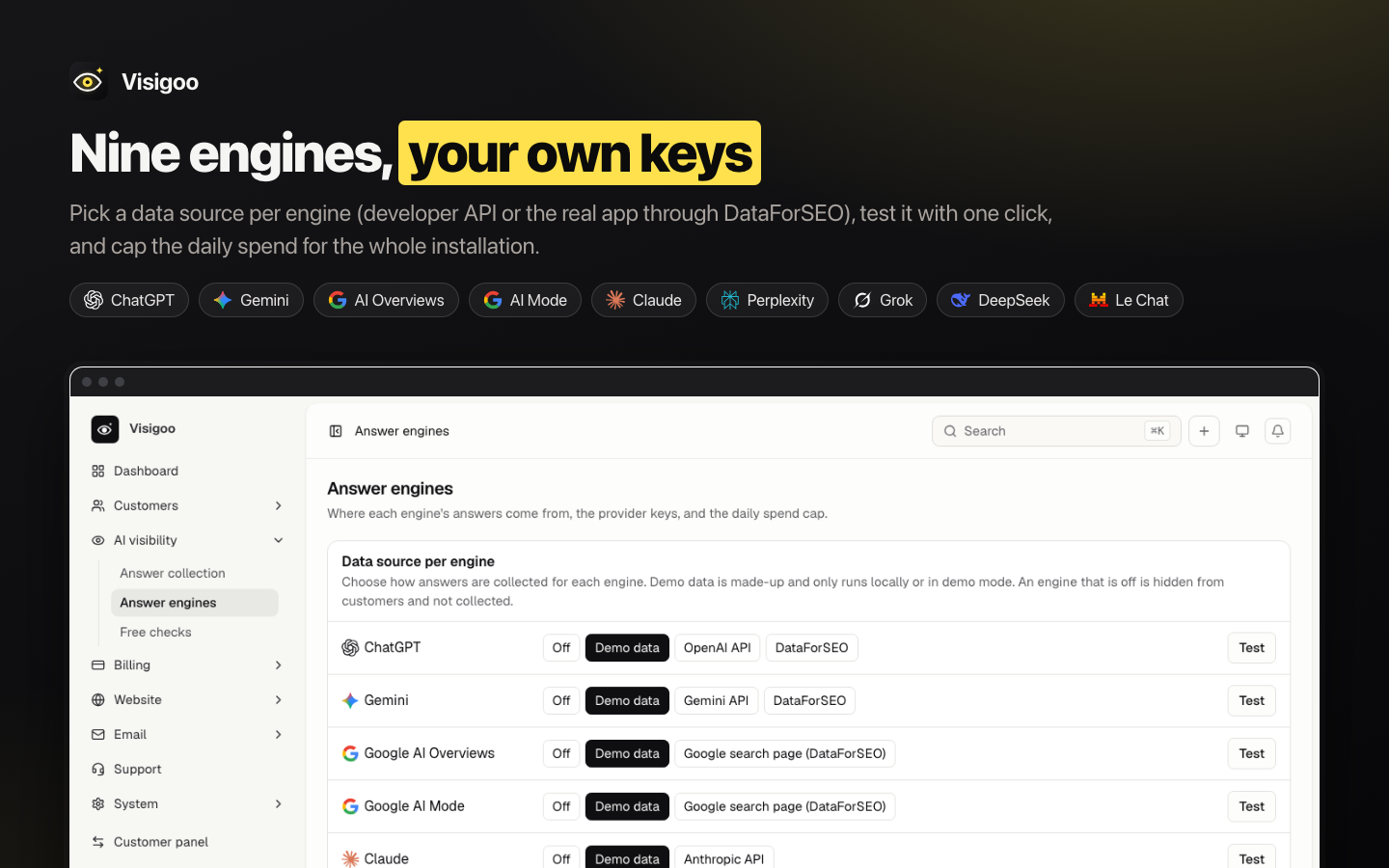
- A daily spend cap for the whole installation (US$25 by default, changeable in Admin panel → AI visibility → Answer engines) stops all collection for the rest of the day once reached.
- The real cost of every answer is recorded and shown per engine and per workspace in Admin panel → AI visibility → Answer collection.
The sample plan prices (Starter US$49, Growth US$149, Agency US$399 a month) are a starting point. Check them against your own cost per answer before you launch: a customer who uses a large allowance in full can cost more than the plan price. The documentation has a table for this.
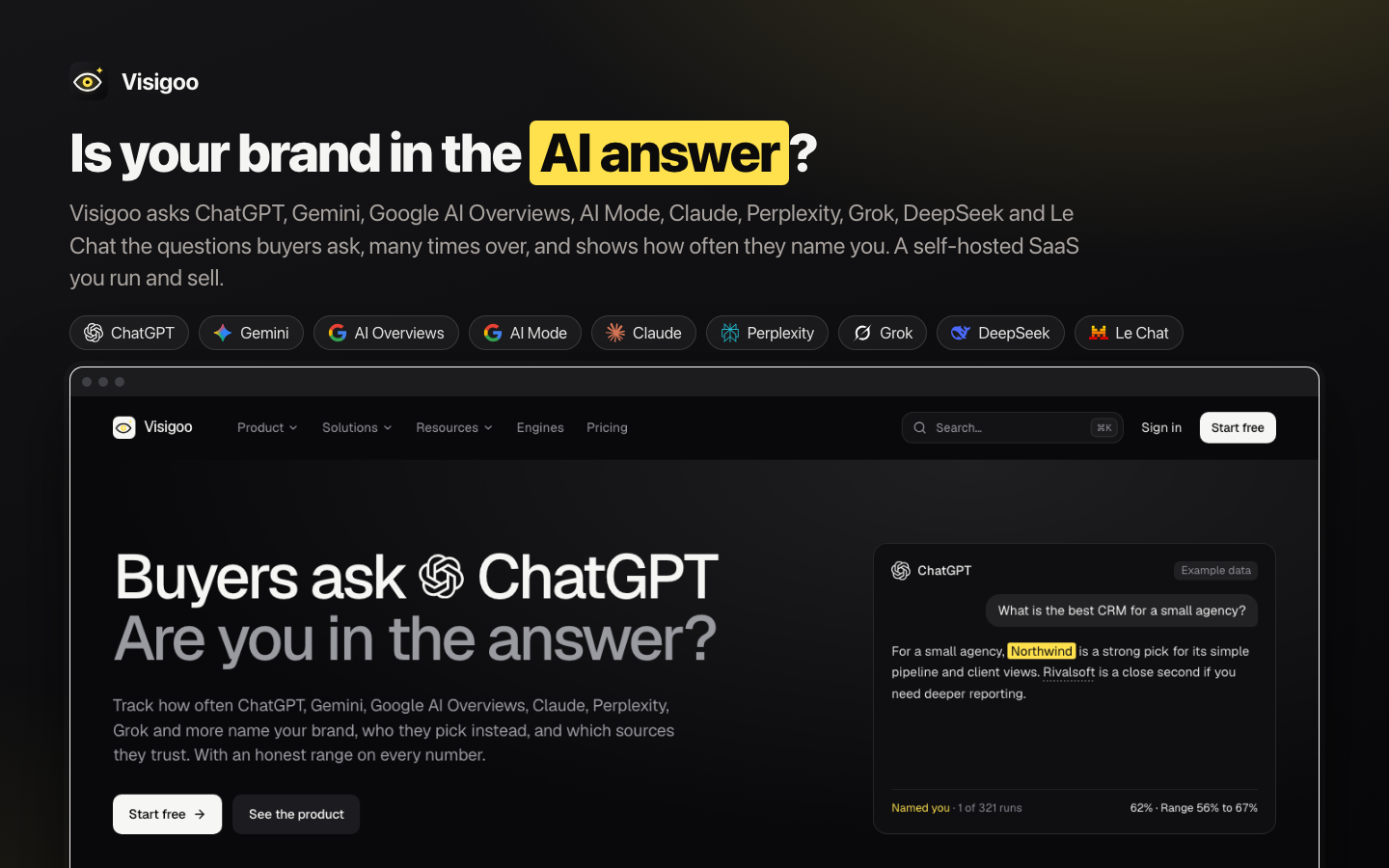
Visigoo is a self-hosted SaaS script, built with the Laravel PHP framework (Inertia and Vue 3 front end), that measures how often AI assistants name a brand when people ask them for recommendations. Your customers add their brand, its competitors and the questions their buyers ask, for example “What is the best CRM for a small agency?”. Visigoo asks those questions several times on every engine, on a schedule, on nine engines: ChatGPT, Gemini, Google AI Overviews, Google AI Mode, Claude, Perplexity, Grok, DeepSeek and Le Chat (Mistral). It stores every answer, and turns them into a mention rate, share of voice and citation rate, the competitors named instead, and the websites the answers cite.
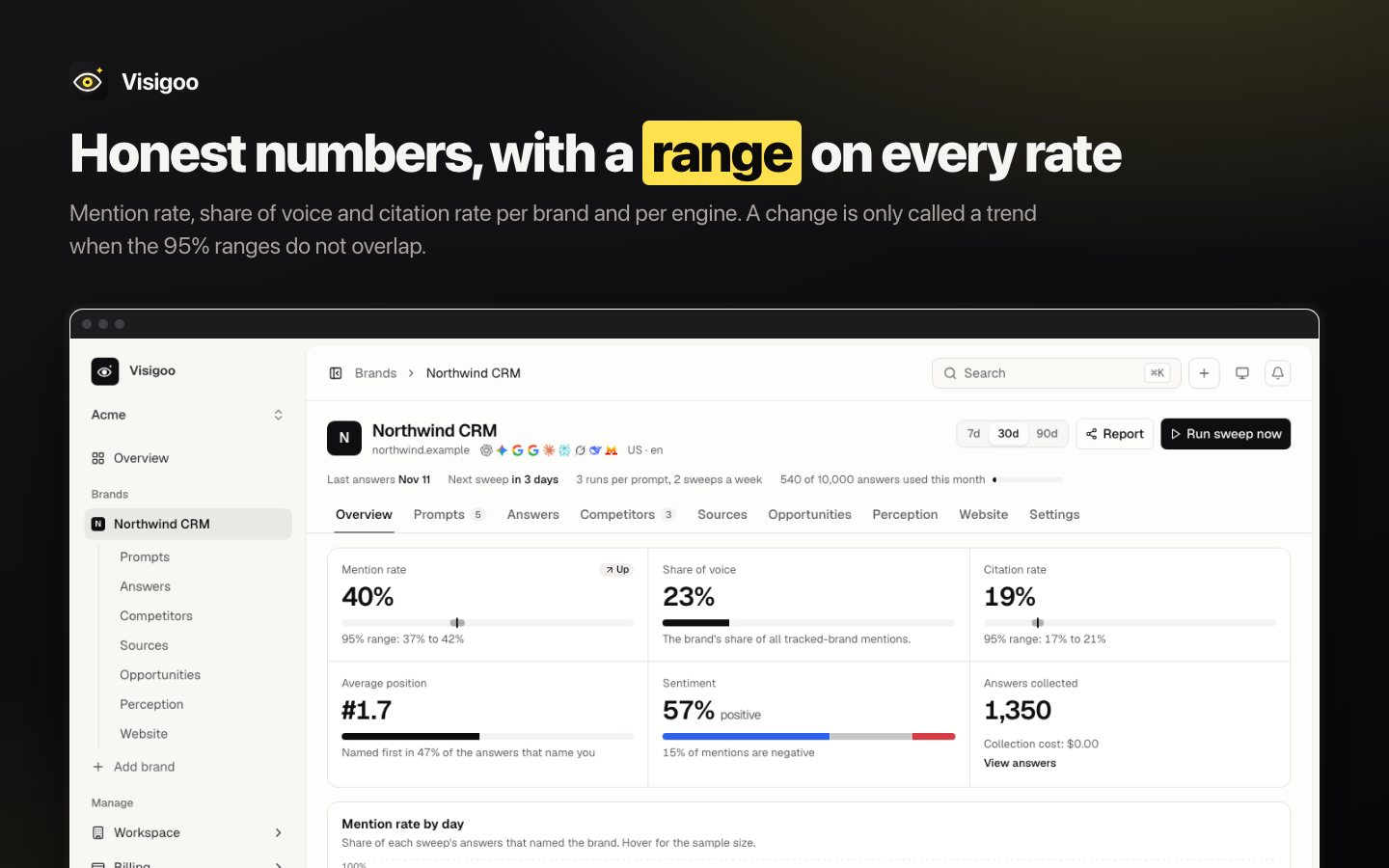
AI answers change from one try to the next, so a single run proves nothing. Visigoo shows every rate with a 95% range and its sample size, calls something a trend only when the ranges do not overlap, and never shows a “rank position”. It reports what the engines said, honestly, and never promises rankings or citations.
It is built as a business you can run from day one: workspaces with members and roles, plans with monthly answer allowances and 7-day free trials, coupons and multiple currencies, checkout through six payment providers, a complete marketing website with pricing, blog and help pages, a browser installer, and an operator panel with engine keys, spend caps, usage per workspace, health checks, jobs, logs and backups.
What’s new in 3.0
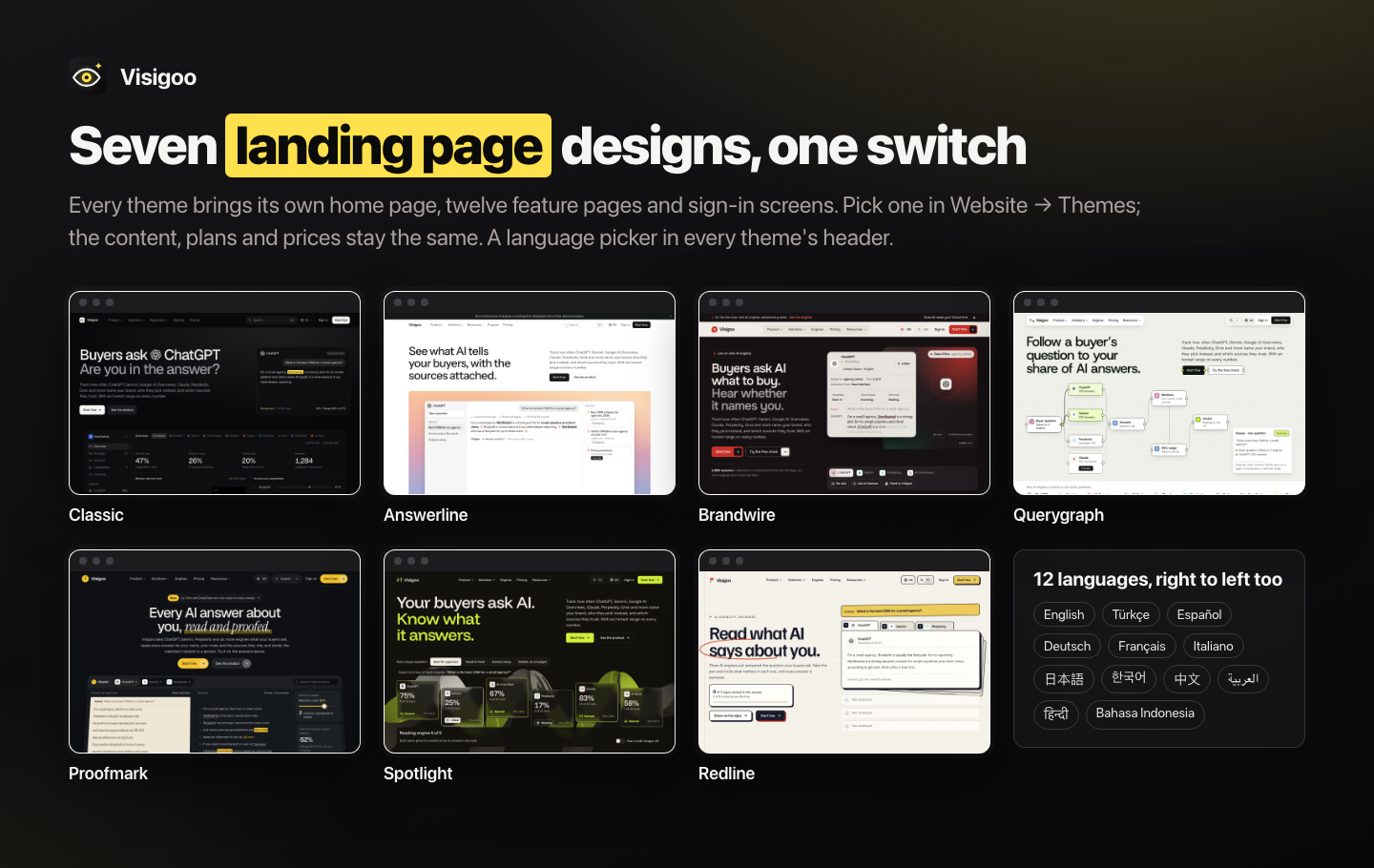
- Seven public-site themes: Classic, Answerline, Brandwire, Querygraph, Proofmark, Spotlight and Redline, each with its own home page, product pages and sign-in screens. Preview and choose one in Admin → Website → Themes; on the live demo, a floating switcher lets you try them all.
- Twelve languages: English, Turkish, Spanish, German, French, Italian, Japanese, Korean, Chinese, Arabic, Hindi and Indonesian, with a language picker in every theme’s header and right-to-left layouts for Arabic.
- Roles that make sense: Owner, Admin, Member and Viewer; a separate Connections permission for keys, sites, ad accounts and webhooks; closing, handing over and billing for the owner alone; custom roles from grouped switches; invitations that keep a custom role; and an operator who works only in the admin panel and impersonates a customer to see their panel.
What’s new in 2.0
- Content drafts: a full page from any brief, every claim fact-checked against the brand’s facts, with JSON-LD, an editable llms.txt, and translations into other languages.
- Publishing: send an approved draft to WordPress, Ghost, Webflow, Shopify or a signed webhook, always as a draft post the customer publishes.
- Impact tracking and refresh alerts: mention and citation rates in the four weeks before and after each page, llms.txt save or ad, with ranges, and an alert when a published page starts losing.
- Customers’ own AI keys and AI gateways: customers can bring their own provider keys (Agency plan by default), and most engines can be collected through OpenRouter, Vercel AI Gateway, Cloudflare AI Gateway, Requesty or LiteLLM, or read through Bright Data or SerpApi.
- Weekly app checks: core questions asked the way people see them in the ChatGPT and Gemini apps, compared with the daily API answers.
- Ads: the ads shown inside AI answers, and fact-checked ad copy sent to the customer’s own Google Ads, ChatGPT ads or Meta (Facebook and Instagram) account as a paused campaign, or exported as CSV.
- ChatGPT Shopping: the row of product cards ChatGPT and Google AI Mode show for buying questions, who holds each slot, the customer’s catalogue read against it, product page checks and a product feed in ChatGPT’s merchant format.
Demo Instructions
Try everything before you buy, no install needed. The live demo is a sandboxed installation with a fictional brand (Northwind CRM) and sixty days of sample answers that are clearly labelled as sample data; demo mode blocks changes to settings, keys and users, but you can sign up, choose a plan and go through the checkout (test mode, no real charge), switch the site theme from the floating switcher and switch the language. It resets itself on a schedule. These logins are public on purpose.
- Website: https://visigoo.laravelbeginner.net
Product pages: https://visigoo.laravelbeginner.net/features/visibility · Customer stories: https://visigoo.laravelbeginner.net/customers · Free check: https://visigoo.laravelbeginner.net/free-ai-visibility-check - Admin panel (operator): https://visigoo.laravelbeginner.net/login
Emailsuper@visigoo.test· Passwordpassword - Customer panel (workspace “Acme”, Growth plan): https://visigoo.laravelbeginner.net/login
Ownerowner@visigoo.test· Adminadmin@visigoo.test· Membermember@visigoo.test· Viewer (read only)viewer@visigoo.test, passwordpasswordfor each - A second, separate customer:
neighbour@visigoo.test·password(shows that customers never see each other’s data) - REST API and MCP: sign in as the owner and open Workspace → API & MCP.
The operator login opens the admin panel (business dashboard, every customer, engines, billing, website and system); the customer logins open the customer panel, each with what its role allows. The admin panel shows a fictional customer base of eighteen companies with plans, trials, payments and usage, so every chart has data.
All third-party services in detail
- OpenAI (ChatGPT answers through the API): the Responses API with its web search tool, on your own OpenAI account and key. Model, prices and key are set in Admin panel → AI visibility → Answer engines. Cost: paid per use by OpenAI (tokens plus web searches).
- Google Gemini: the Gemini API with Google Search grounding, on your own Google AI Studio key. Cost: paid per use by Google (tokens plus grounded searches).
- Anthropic (Claude answers): the Messages API with web search, through Anthropic’s official PHP SDK, on your own Anthropic key. Cost: paid per use by Anthropic (tokens plus web searches).
- Perplexity: the Perplexity API on your own key. Cost: paid per use by Perplexity.
- xAI (Grok answers): the Responses API with web search, on your own xAI key. Cost: paid per use by xAI, which reports the cost of every answer.
- DeepSeek: the DeepSeek API with web search, on your own key. Cost: paid per use by DeepSeek.
- Mistral (Le Chat answers): the Conversations API with web search, on your own key. Cost: paid per use by Mistral.
- DataForSEO (optional): collects the answers shown inside the ChatGPT and Gemini apps rather than the developer APIs, and reads Google AI Overviews and AI Mode from the Google results page, on your own DataForSEO login. It also supplies the monthly AI search volume for questions. Cost: paid per task by DataForSEO.
- Bright Data and SerpApi (optional): Bright Data reads the ChatGPT and Gemini apps and Google AI Mode; SerpApi reads Google AI Overviews, AI Mode and Gemini. Either can also run the weekly app checks. Cost: paid per record or per search by each provider.
- AI gateways (optional): OpenRouter, Vercel AI Gateway, Cloudflare AI Gateway, Requesty, or a LiteLLM proxy you run yourself, on your own account, as the data source for the engines each supports. Cost: each gateway’s own pricing on top of, or including, the model provider’s.
- Google Ads API and a Meta app (optional): to let customers send ads to their own Google Ads or Meta accounts, you register a Google Ads developer token and OAuth client and a Meta app (Marketing API, which needs Meta’s App Review). ChatGPT ads use each customer’s own OpenAI Ads key and need nothing from you. Cost: free to register; the customers pay for their own ads.
- Stripe, Paddle, Polar, Creem, Dodo Payments, Lemon Squeezy (checkout; you choose one with one setting, and each one you use needs your own account): subscriptions for your plans. Each provider has its own seller approval and terms. A command creates your plans and prices at the provider for you (Lemon Squeezy products are created by hand, as its API does not allow it). Cost: transaction and service fees of each provider.
- Email delivery (required): SMTP, or Postmark, Amazon SES, Resend, SendGrid, Brevo, Mailtrap, Mandrill or OneSignal through the email provider screen, each with a test button. Cost: your mail provider’s fees.
- Upstash QStash (optional): runs background jobs on shared hosting where a queue worker cannot stay running; QStash calls your site over HTTPS to run each job. Cost: billed per message above Upstash’s free tier.
- Google and GitHub sign-in (optional): your own OAuth apps. Cost: free.
- Cloudflare Turnstile or Google reCAPTCHA (optional): spam protection on sign-up and contact forms, your own keys. Cost: each provider’s own pricing.
- Storage and CDN (optional): Amazon S3, Cloudflare R2, DigitalOcean Spaces, Backblaze B2, Wasabi, Google Cloud Storage, MinIO or Bunny for the media library, with any CDN in front. Cost: each provider’s own pricing.
- AI provider for drafts, briefs and support replies (optional): content briefs, content drafts and their translations, fact checks, ad copy and support-reply drafts run through the free, MIT-licensed
laravel/aipackage with a provider you choose (Gemini, OpenAI, Anthropic, Cerebras and others), on your own key. Cost: paid per use by that provider. - Sentry (optional): error reporting, used only if you install
sentry/sentry-laravel. Cost: Sentry’s own pricing. - Hosting (required): PHP 8.4 and MySQL 8 / MariaDB 10.6 (PostgreSQL and SQLite also work), one cron entry, and a queue worker or QStash. HTTPS for live payments and webhooks. Cost: your hosting costs.
Credentials and licences (no author keys included)
Every credential in the download is an empty value or a placeholder that you replace with your own.
- AI providers:
OPENAI_API_KEY,GEMINI_API_KEY,ANTHROPIC_API_KEY,PERPLEXITY_API_KEY, the DataForSEO login, and every gateway, Bright Data, SerpApi, Google Ads and Meta key are blank in.env.exampleand.env.production.example. They are entered in the installer or in Admin panel → AI visibility → Answer engines, stored in your.env, read only on your server and never sent back to the browser. - Payment providers: no publishable key, secret key, product id, price id or webhook secret of ours is in the source. Payments can only ever reach the accounts whose keys you enter.
- Anthropic SDK and laravel/ai: both are official, open-source packages installed by Composer and governed by their own licences (MIT), which permit commercial use. They are not author services and route nothing through the author.
- Everything else (mail, storage, captcha, sign-in, QStash, error reporting) is blank in every example file and supplied by you.
- SaaS licence: Visigoo is built to be sold to your own customers as a subscription. Charging end users for access requires the Envato Extended Licence.
AI Disclosure
AI tools were used to make this item. The source code, the documentation and the graphics were created with AI assistance (Claude Code with Anthropic’s Claude Opus 5.5 model for code and documentation). Our team reviewed and tested the result and maintains and supports the item. Gallery and documentation screenshots are captures of the running product; the description banners and the preview image are composed from those screenshots.
AI as the subject of the product. Visigoo sends the questions your customers enter, with a country code, to the AI provider you choose for each engine, over the internet, and stores the answers on your server. No personal data about your customers is sent. Answers are machine output: Visigoo reports what the engines said, which can be wrong, outdated or different from what a person sees in the consumer apps. Every answer records how it was collected (developer API or app interface) and which model produced it.
Optional AI features: content briefs, page drafts and their translations, ad copy and fact checks for your customers, and support-reply drafts for your staff, through laravel/ai and your own key. Every draft is checked against the brand’s own facts, leaves a visible gap for a fact it was not given, and is never published or sent without a person: pages go to the customer’s site as drafts and ads as paused campaigns.

Test card: plans are paid through the payment provider you choose (Stripe, Paddle, Polar, Creem, Dodo Payments or Lemon Squeezy). Each has a sandbox or test mode; Stripe checks out in test mode with card number 4242 4242 4242 4242, any future expiry date and any CVC.
Note: All supported payment services (Stripe, Paddle, Polar, Creem, Dodo Payments and Lemon Squeezy) are third-party services and may charge transaction fees or other service fees depending on their pricing plans. Most require merchant account approval and verification before accepting live payments. Merchant-of-record providers (Paddle, Polar, Creem, Dodo Payments, Lemon Squeezy) review the product you sell: confirm with them that they accept a SaaS of this kind before going live. These services are not included in the purchase price, and buyers are responsible for creating their own accounts, completing any required approval processes, configuring API keys and webhooks, and covering all applicable fees.
Documentation
The package includes a full guide in HTML and PDF (visigoo-docs/, about 135 pages) with screenshots throughout. It explains how the system works before how to click it: the architecture (one Laravel app, the scheduler, the queue and your provider accounts), and step-by-step workflows for the customer journey from sign-up to paid plan, a sweep end to end (allowance claim, spend cap, provider call, stored answer, analysis), how an answer becomes a rate with a 95% range, AI analysis and briefs, alerts and the weekly digest, payments and webhooks, the monthly cycle, the free check, the site check and AI traffic, reports and share links, and workspace data isolation.
It then covers installing on shared hosting with the browser installer or on a VPS (nginx, Supervisor and cron configs included), running a public demo, connecting each AI provider and each payment provider (webhook URLs and sandbox settings), what an answer costs and how to price your plans, every customer and operator screen, the marketing website (page editor and blocks, every public page, the twelve product pages, customer stories, site search, SEO), the seven site themes, the twelve languages and right-to-left layouts, roles and permissions, demo mode, every version 2 feature (content drafts, publishing, own keys, AI gateways, app checks, ads, ChatGPT Shopping, impact tracking), email, branding, storage, sign-in, SSO and SCIM, security defaults, the REST API reference with examples and error codes, MCP client setup, every inbound webhook URL, environment variables, roles and permissions, the data model, upgrading, backups, adding your own answer collector, the command reference, FAQ and troubleshooting.
What runs where (included)
- One Laravel web application (
visigoo/): the marketing website, the customer panel, the operator panel, the browser installer, the scheduler tasks and the background jobs. There is no mobile app and nothing to compile on the server:vendor/and the built front end are included, so you upload, open your domain and install. - How collection runs: the scheduler checks every 15 minutes for brands that are due and queues their sweep; each answer is one background job that claims the allowance, checks the spend cap, calls the provider, stores the raw answer and analyses it. A failed analysis never pays twice.
- Shared hosting: works with one cron entry and Upstash QStash for jobs. A VPS with a queue worker is recommended for agencies with many brands.
Key Value Propositions
- For your customers (brands, startups, marketing teams): see how often ChatGPT, Gemini, Google AI Overviews, AI Mode, Claude, Perplexity, Grok, DeepSeek and Le Chat name them, which questions they lose, who gets named instead, and which websites the answers trust, per engine, with an honest range on every number.
- For agencies: many brands in one workspace, white-label PDF reports and share links for clients, fact-checked drafts sent to the client’s site, ad copy sent to the client’s ad account as paused campaigns, alerts in Slack, the REST API and MCP, team roles with a separate Connections permission, their own AI keys, single sign-on and directory sync on the Agency plan, and a custom theme built from their brand colour.
- For you, the operator: a ready SaaS business: plans with answer allowances, trials, coupons, currencies and six payment providers, a marketing website in seven themes and twelve languages, and an operator panel that shows spend per engine, usage per workspace and every failure, behind a hard daily spend cap.
- For developers: Laravel 13, Inertia 3 and Vue 3 with TypeScript, strict types and PHPStan, a Pest test suite of more than 1,600 tests, and one class per answer collector behind a small interface, so adding an engine is one file and one line of config.
Content Disclosure
- The demo brand, competitors, questions and answers (Northwind CRM, Contoso CRM, Fabrikam, Rivalsoft) are fictional and are labelled as sample data. They are created only by the demo command or the installer’s optional “example content” box; a production install starts empty.
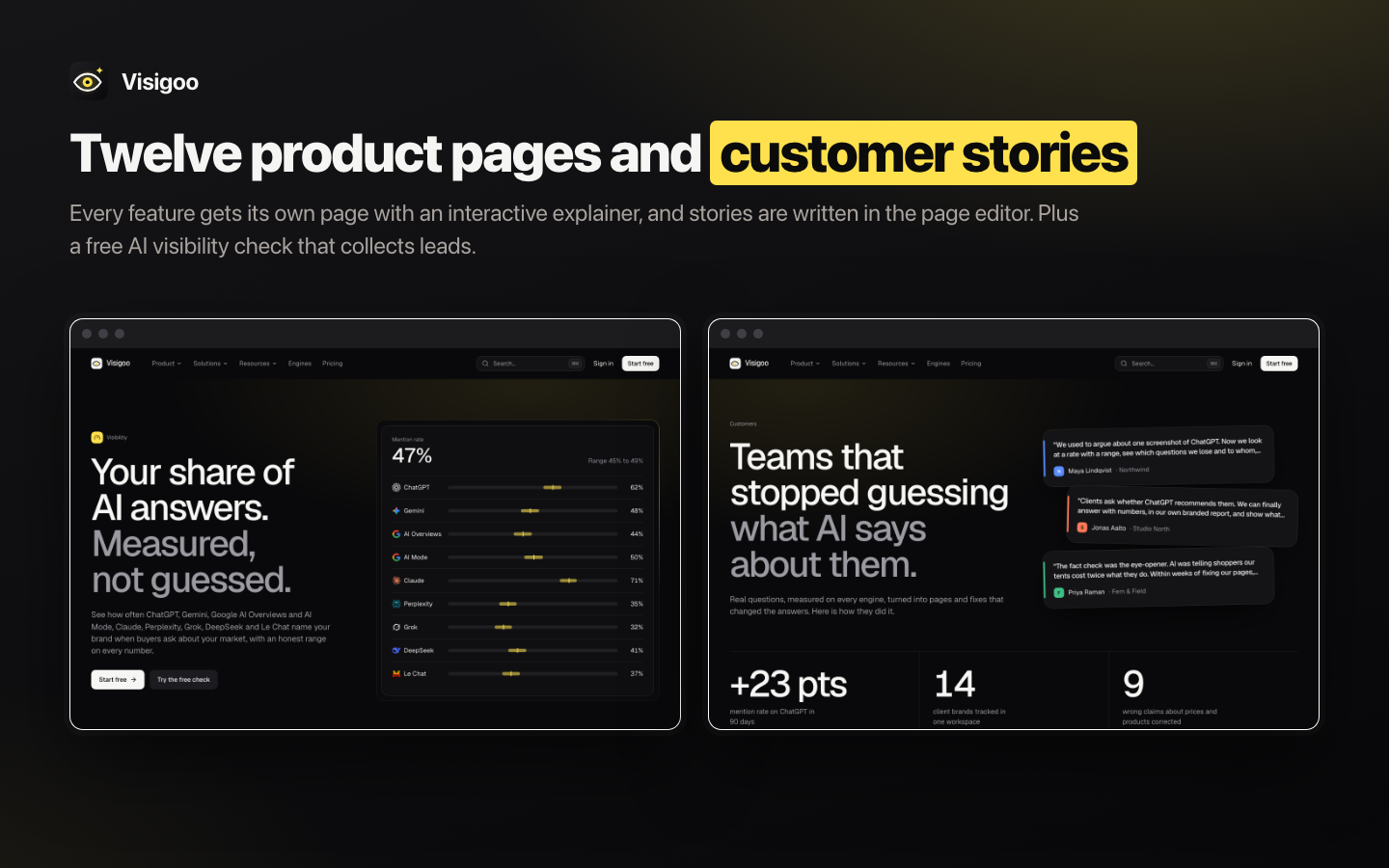
- The three customer stories (Northwind, Studio North, Fern & Field) are fictional examples and carry an “Example story” badge; the brands and numbers on the product pages and in each theme’s home page are fictional illustrations. Replace the stories with real customers, with their permission, before you present them as case studies.
- The marketing pages, pricing, blog posts, help pages and FAQ are original and editable. The interface and product pages ship in twelve languages; the editable pricing and FAQ blocks ship in English and Turkish.
- The site themes’ fonts are self-hosted under the SIL Open Font License, with the licence file beside them.
- The legal pages (privacy policy, terms) ship as drafts. They are starting templates, not legal advice; have them reviewed for your business and country before you sell.
- Engine names and marks (ChatGPT, Gemini, Google AI Overviews, AI Mode, Claude, Perplexity, Grok, DeepSeek, Le Chat) appear only to say which services the product measures. They belong to their owners, and Visigoo is not affiliated with or endorsed by any of them.
Running this service makes you responsible for your customers’ accounts and payments, for following each AI provider’s and data provider’s terms of use (including their rules on automated queries), and for the privacy, consumer and tax rules of the countries you sell in. Visigoo provides the software; the business and its accounts are yours.
Privacy & Data
No telemetry. The package sends no data to the author and has no licence phone-home. Every third-party identifier (AI keys, payment keys, captcha, sign-in) is blank and supplied by you, so the data each service sees goes to your own accounts. Only question text and a country code are sent to the AI providers. Customers can download their data and close their account from their own settings, and closed accounts are deleted after a grace period.
Disclaimer
Visigoo measures what AI assistants answered at the time of each run, through their developer APIs or an AI gateway (or through DataForSEO, Bright Data or SerpApi for the consumer apps and Google’s AI answers). API answers can differ from what a person sees in the apps, and answers change over time. Visigoo does not guarantee, and must not be sold as guaranteeing, any ranking, mention or citation. The purchase covers the source code only: hosting, AI usage, payment fees, email delivery and every other third-party service listed above are paid by you, on your own accounts. Basic familiarity with PHP/MySQL hosting, cron jobs and your chosen AI and payment providers is recommended before launching.
OpenAI, ChatGPT, Google, Gemini, Google Ads, Anthropic, Claude, Perplexity, xAI, Grok, DeepSeek, Mistral, Le Chat, Meta, Facebook, Instagram, DataForSEO, Bright Data, SerpApi, OpenRouter, Vercel, Cloudflare, Requesty, LiteLLM, WordPress, Ghost, Webflow, Shopify, Laravel, Stripe and all other product names, logos and trademarks mentioned here belong to their respective owners. Visigoo is an independent product and is not affiliated with or endorsed by any of them.
What’s Included
- Full Laravel 13 source code (
visigoo/) with the Vue 3 / Inertia front end, ready to upload: Composer dependencies installed and the front end built, plus everything needed to rebuild both - A browser installer (
/setup): requirements check with fixes for cPanel and Plesk, database, email, payments and AI keys, the first account, and a lock when it finishes - Database migrations and seeders: roles and permissions, four plans (Free, Starter, Growth, Agency) with USD and EUR prices, currencies, the menu, the marketing pages, blog posts and help pages
- A demo command with a sample brand and sixty days of labelled sample answers, and a demo-reset command for a public demo
- Collectors for OpenAI, Gemini, Anthropic, Perplexity, xAI, DeepSeek, Mistral, DataForSEO and Google AI Overviews / AI Mode, plus Bright Data, SerpApi and five AI gateways (OpenRouter, Vercel AI Gateway, Cloudflare AI Gateway, Requesty, LiteLLM)
- Publishers for WordPress, Ghost, Webflow, Shopify and signed webhooks, and ad senders for Google Ads, ChatGPT ads and Meta ads (paused campaigns only)
- Checkout for Stripe, Paddle, Polar, Creem, Dodo Payments and Lemon Squeezy, with signature-checked webhooks and a command that creates your plans at the provider
- An interface in twelve languages (English, Turkish, Spanish, German, French, Italian, Japanese, Korean, Chinese, Arabic, Hindi, Indonesian) with right-to-left layouts and an in-panel translation editor to add more
- Seven public-site themes, and eleven panel themes in light and dark
- A Pest test suite (more than 1,600 tests) and PHPStan configuration
- Complete documentation in HTML and PDF (
visigoo-docs/) and a START-HERE file
Key Features
- Brands: name, domains, other names (aliases), country and language, the engines to measure, runs per prompt (1 to 10) and sweeps per week (1 to 7). The form shows the answers a brand will use per month as you type.
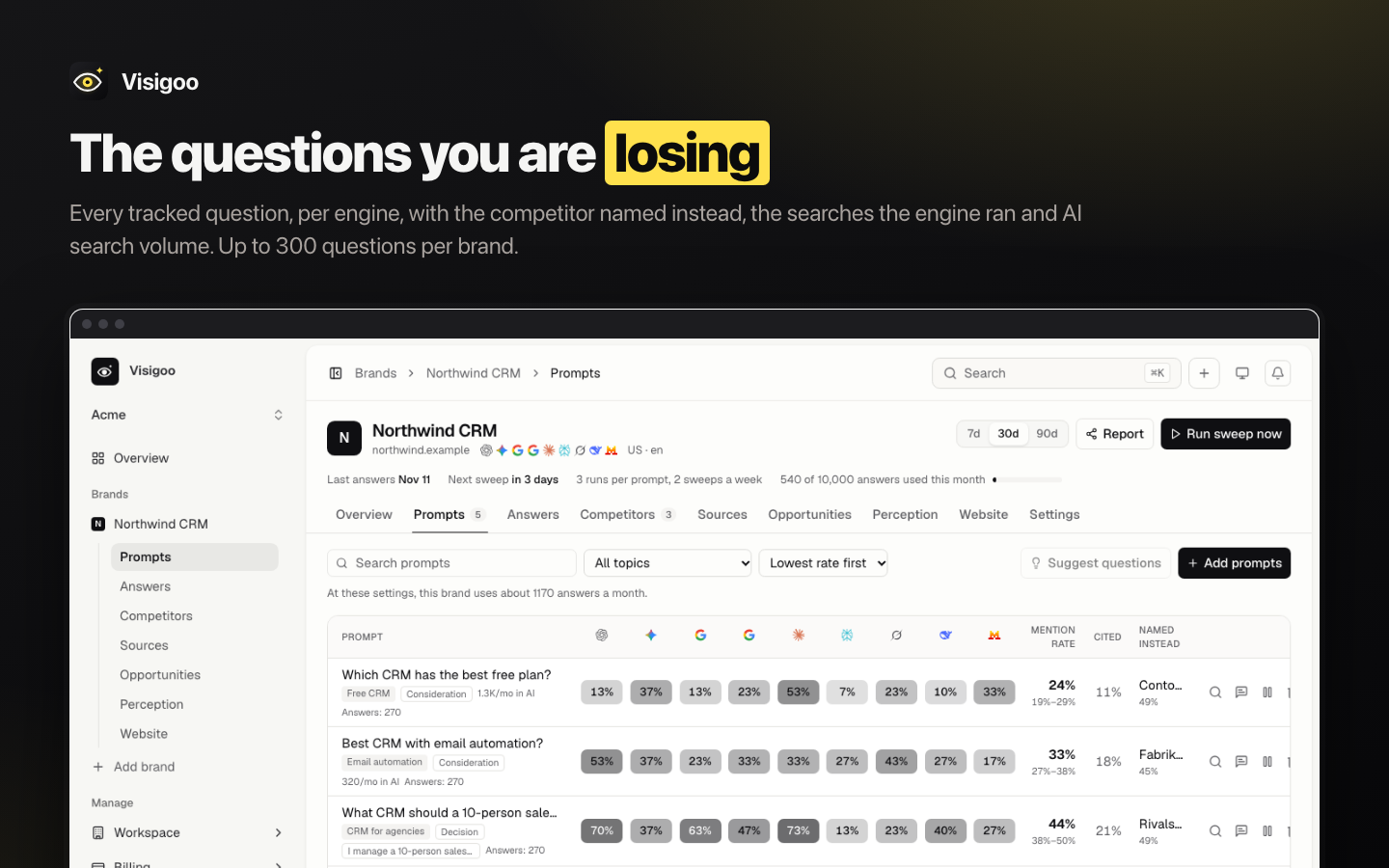
- Prompts: add questions one per line with an optional topic, up to 300 per brand. Pause a prompt to stop spending on it while keeping its history.
- Sweeps and runs: every active prompt on every chosen engine, several times per sweep, on a weekly schedule or with “Run sweep now”. A repeated sweep on the same day only fills in what is missing, so the same answer is never paid for twice.
- Mention rate with a 95% range: the share of answers that name the brand by name, alias or domain, with a Wilson score range and the sample size; under 30 answers the rate is marked low confidence.
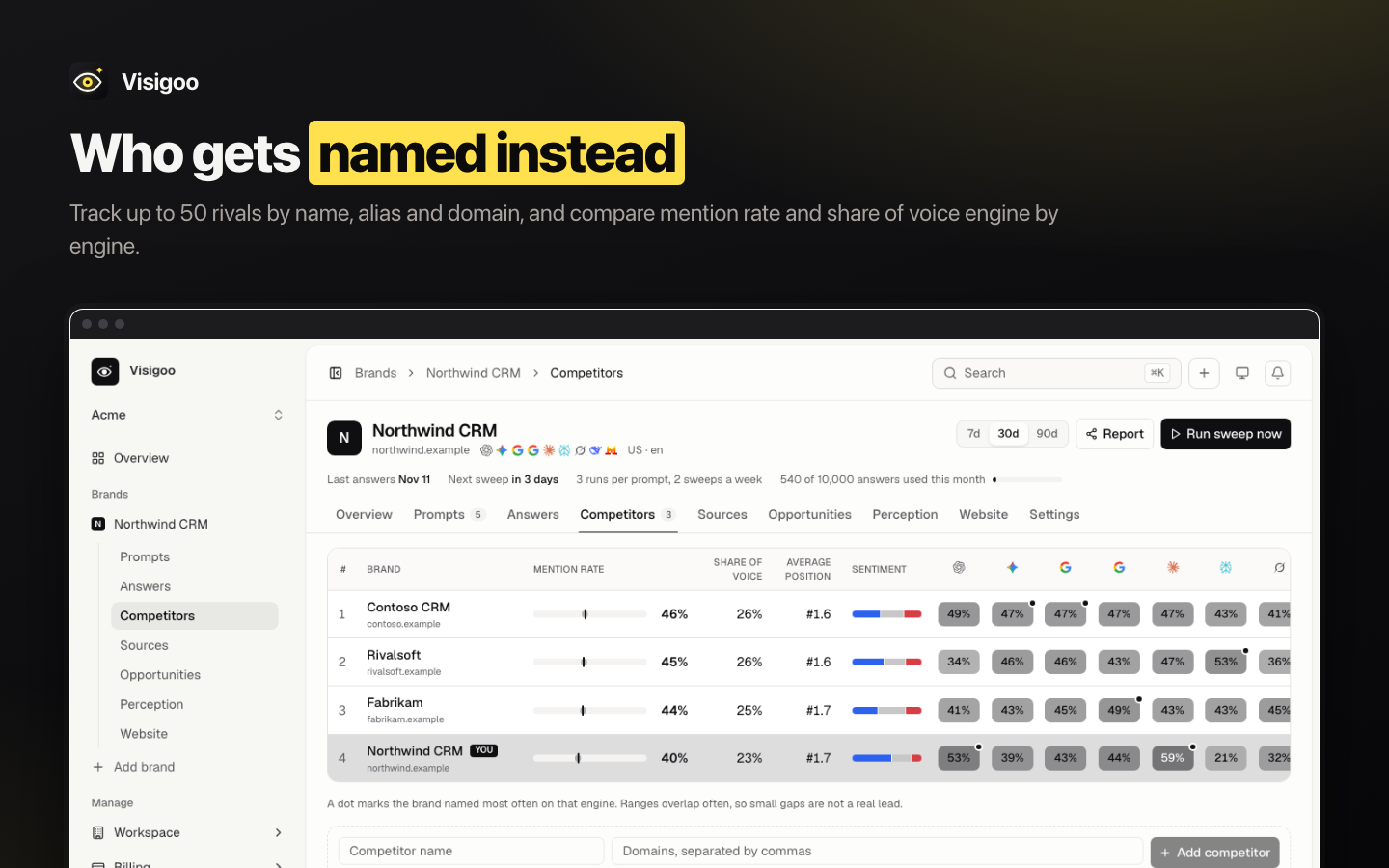
- Share of voice: the brand’s share of all tracked-brand mentions.
- Citation rate: the share of answers that cite one of the brand’s own domains as a source, with its range.
- Trends that mean something: up or down only when the 95% ranges of the two periods do not overlap; otherwise “no clear change”. Periods of 7, 30 and 90 days.
- By engine: each engine’s rate and range side by side, with the collection method (API or app interface) shown, so engines are compared with care.
- Prompts to win: every question’s rate overall and per engine, with the competitor named most often instead, so a team sees which questions it is losing.
- Competitors: up to 50 per brand, with domains and aliases, and a brand comparison of mention rate and share of voice.
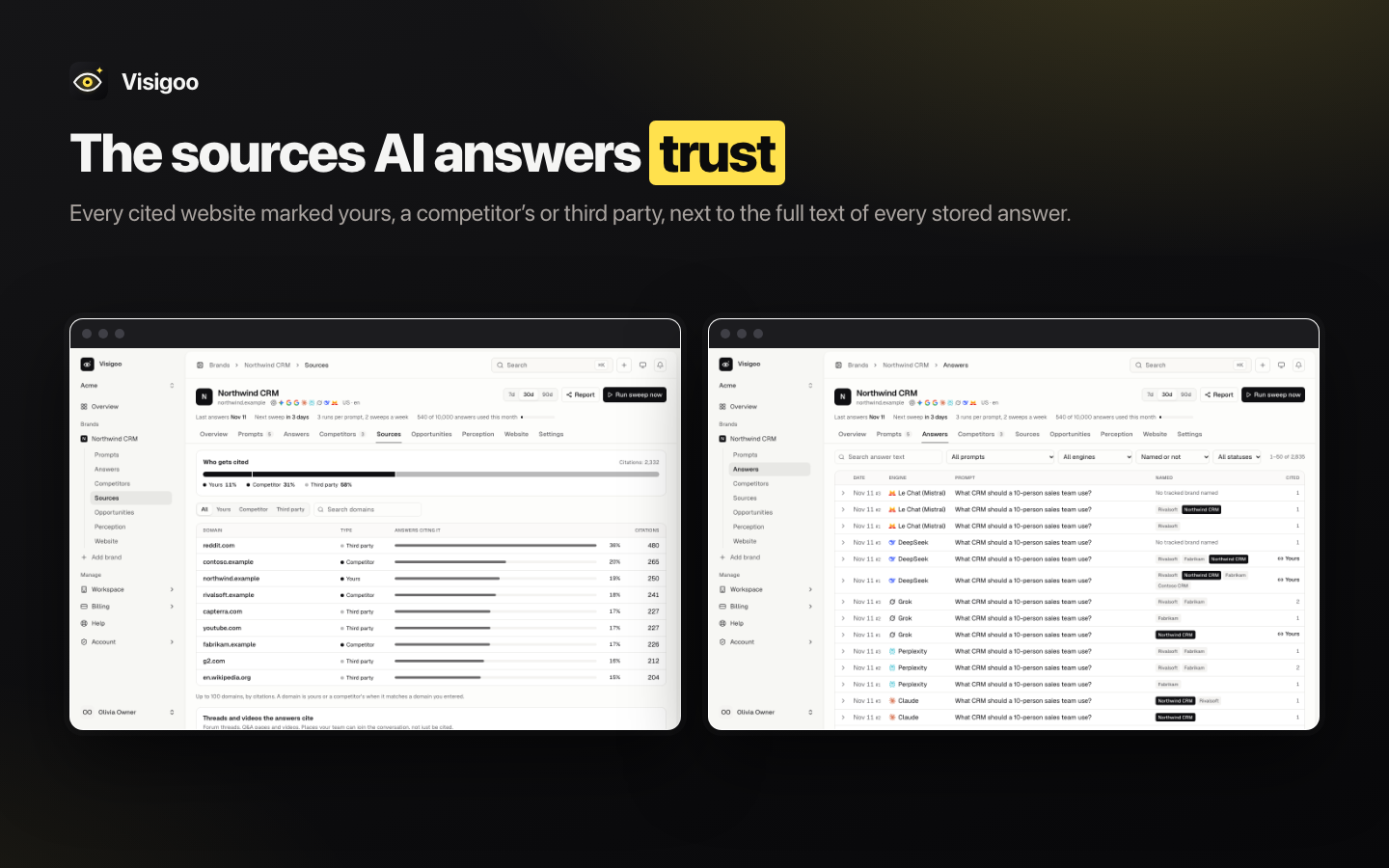
- Sources: every domain the answers cite, how often and in how many answers, marked Yours, Competitor or Third party, so the pages worth earning a place on stand out.
- Answer browser: the full text of every answer with the brands it named and the links it cited; filter by engine, status, prompt and named brand, or search the text. Failed answers show their reason.
- Mention rate by day: a daily chart with the sample size of each day on hover.
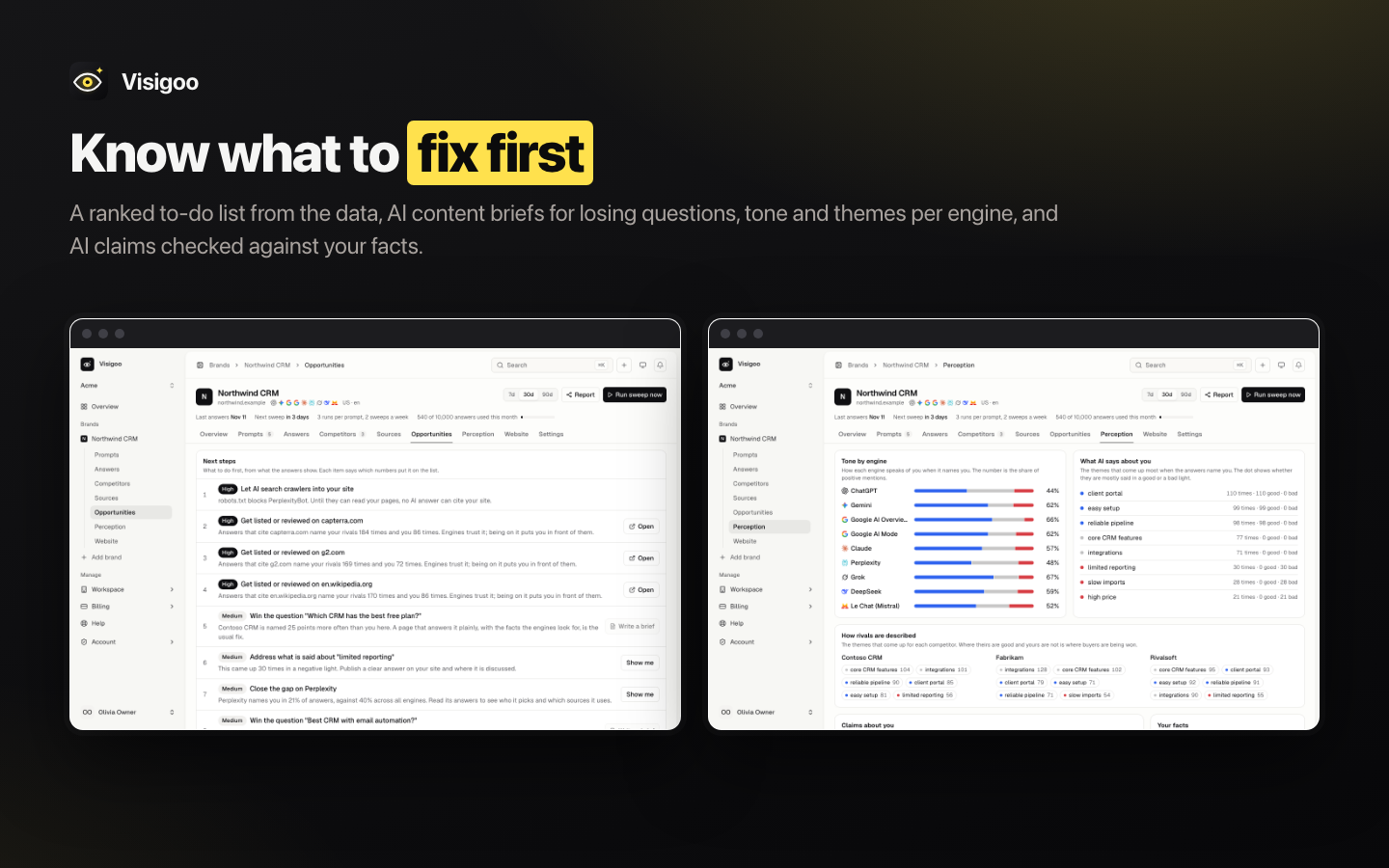
- Position and sentiment: the average place the brand is named in, how often it is named first, and the tone of every mention, per engine and per competitor.
- AI analysis (optional): themes behind each mention (“easy setup”, “high price”) and the claims answers make about the brand, read by the AI provider you choose.
- Fact check: the brand enters its facts; claims AI makes are marked correct, wrong or not covered.
- Opportunities: a ranked to-do list from the data: questions rivals win, third-party sites that cite rivals but not the brand, weak engines, negative themes and site problems.
- AI content briefs: an outline for a page that could win a losing question, from the answers, rivals, cited sites and the searches the engines ran.
- Question suggestions and AI search volume: buyer questions suggested by AI with their stage (awareness, consideration, decision), personas to ask as, and monthly AI search volume per question and topic from DataForSEO.
- Fan-out searches: the web searches each engine ran to answer a question.
- Forum and video sources: the Reddit threads, YouTube videos and Q&A pages the answers cite.
- Products and ads in AI answers: product cards and paid placements shown by ChatGPT and Google AI Mode, marked yours, a competitor’s or someone else’s.
- Content drafts: a full page (title, meta description, body, FAQ) from any brief, every claim fact-checked against the brand’s facts, visible gaps instead of guessed facts, Markdown and HTML export, Article and FAQPage JSON-LD, and translations into any language as linked drafts.
- JSON-LD and llms.txt: Organization, WebSite and Product markup generated from the brand, an editable llms.txt, and a live check that the site serves both correctly.
- Publishing: approved drafts sent to WordPress, Ghost, Webflow, Shopify or a signed webhook as a draft post, updated in place when sent again (Growth and Agency plans by default).
- Impact tracking and refresh alerts: each page sent, llms.txt saved, ad sent or note, with the mention and citation rates four weeks before and since and their ranges; an alert when a published page starts losing.
- Ads: ads shown inside AI answers and the questions where rivals advertise; responsive search ad copy, a ChatGPT chat card and a Meta link ad, fact-checked line by line; CSV export, or a paused campaign in the customer’s own Google Ads, OpenAI Ads or Meta account.
- ChatGPT Shopping: the product shelf in ChatGPT and Google AI Mode answers (slot map, shelf share, products, prices and shops shown, buying questions missed), a catalogue of up to 2,000 products with CSV import, product page checks (crawler access, Product markup, price match) and a product feed in ChatGPT’s merchant format.
- Customers’ own AI keys: a workspace can enter its own OpenAI, Gemini, Anthropic, Perplexity, xAI, DeepSeek, Mistral, OpenRouter or Requesty key, checked, encrypted and never shown again; its answers do not count toward your daily spend cap.
- AI gateways and app checks: collect most engines through OpenRouter, Vercel AI Gateway, Cloudflare AI Gateway, Requesty or LiteLLM, read the consumer apps through DataForSEO, Bright Data or SerpApi, and compare core questions weekly between the apps and the APIs.
- Multiple markets: track a brand in up to ten country and language pairs, with a market filter on every screen.
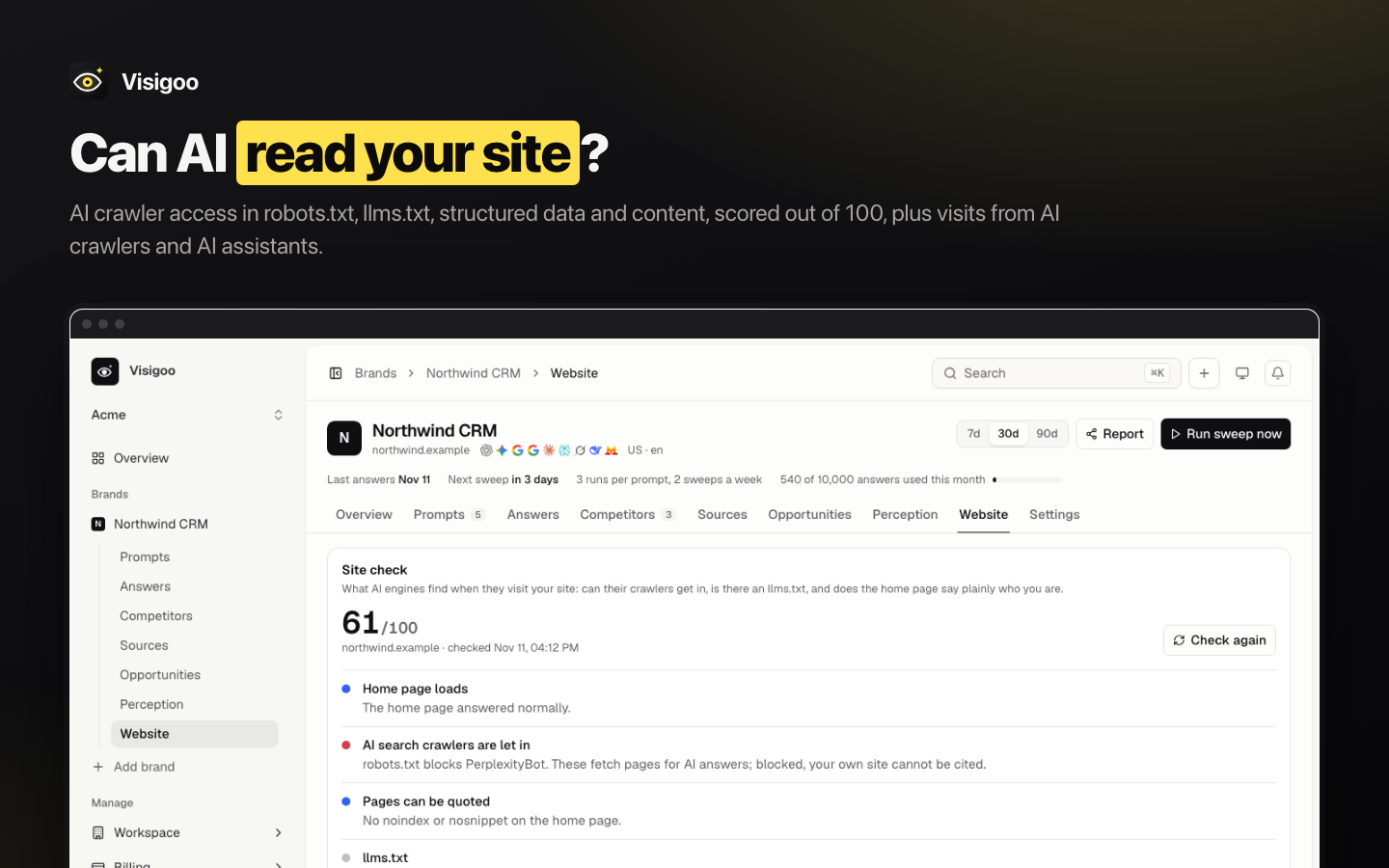
- Site check: AI crawler access in robots.txt (search and training bots apart), noindex, llms.txt, sitemap, structured data and content, scored out of 100, with a ready llms.txt draft.
- AI traffic: AI crawler visits and visitors arriving from AI assistants, from a tracking pixel, a server snippet or an access-log upload.
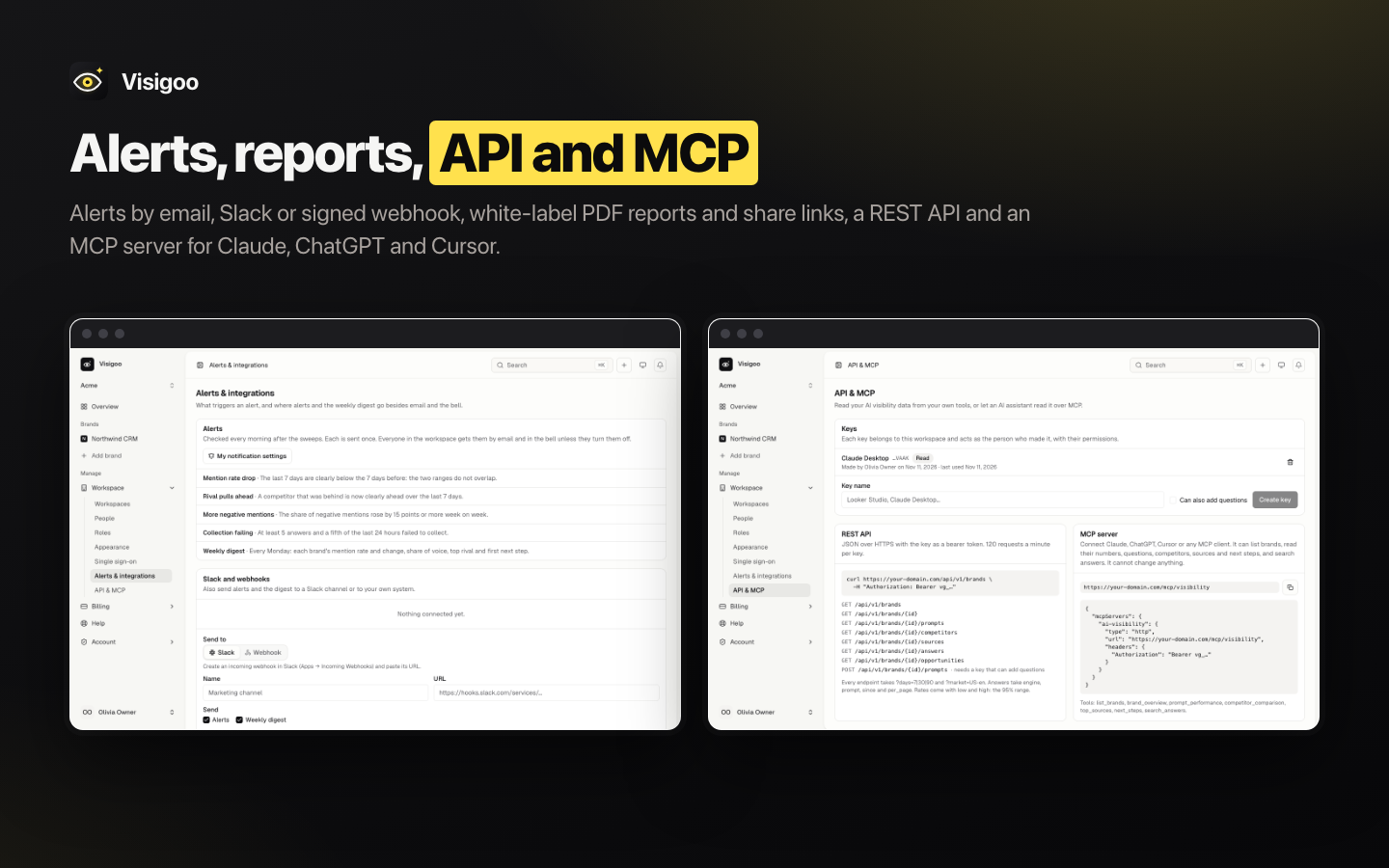
- Alerts and weekly digest: mention drops, rivals pulling ahead, negative mentions and failing collection, by email, in the bell, in Slack or to a signed webhook.
- Client reports: PDF, read-only share links and white-label branding (logo, name, colour) for agencies, plus CSV exports.
- REST API and MCP server: workspace keys for the API and for Claude, ChatGPT, Cursor and other MCP clients.
- Free AI visibility check: a public lead magnet on your site that grades any brand A to F in a minute and collects the visitor’s email for you.
- Workspaces and teams: owner, admin, member and viewer roles, a Connections permission for everything that holds a secret or spends money, custom roles from grouped switches, email invitations that keep a custom role, seat limits per plan, and ownership transfer. Closing, handing over and billing belong to the owner alone.
- Account security: two-factor authentication, passkeys, active-session list, connected accounts, Google and GitHub sign-in, a password confirmation before sensitive changes, and security alerts by email.
- Single sign-on and directory sync (Agency plan): SAML and OpenID Connect, domain claiming with DNS verification, just-in-time provisioning and SCIM.
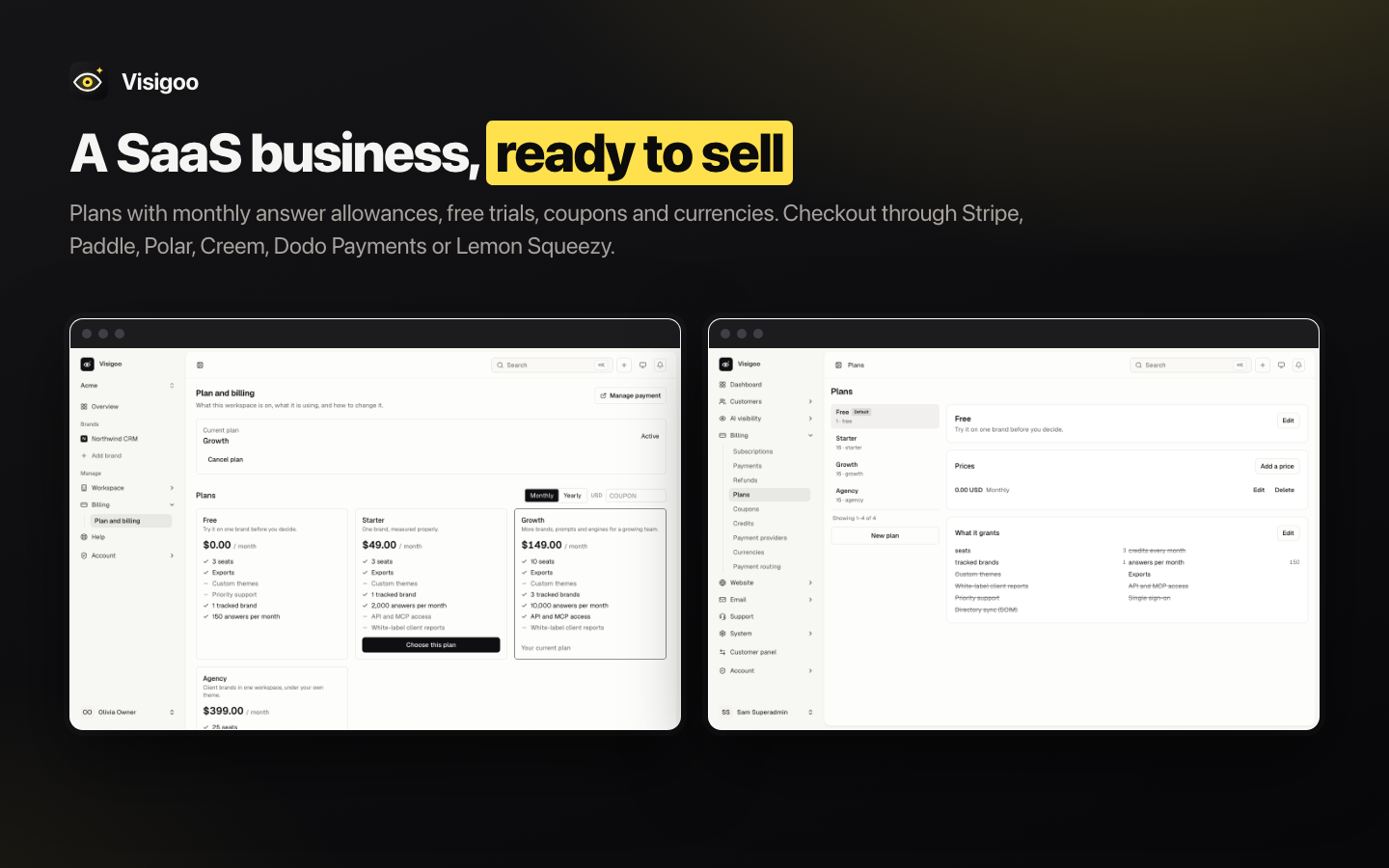
- Plans and billing: plans with monthly answer allowances, brand and seat limits, 7-day trials without a card, monthly and yearly prices, multiple currencies with routing by country, coupons, a credits ledger, refunds with approval, and the provider’s customer portal for invoices and cards.
- Six payment providers: Stripe, Paddle, Polar, Creem, Dodo Payments and Lemon Squeezy, switched with one setting; signature-checked webhooks, de-duplicated events, and an hourly reconciliation that catches lost webhooks.
- Answer engines screen: choose the data source per engine, enter keys, models and prices, run a one-click test call, and set the daily spend cap, without editing files.
- Answer collection screen: spend today against the cap, spend this month, answers and failures per engine, the top workspaces by usage, and the latest failures with their reasons.
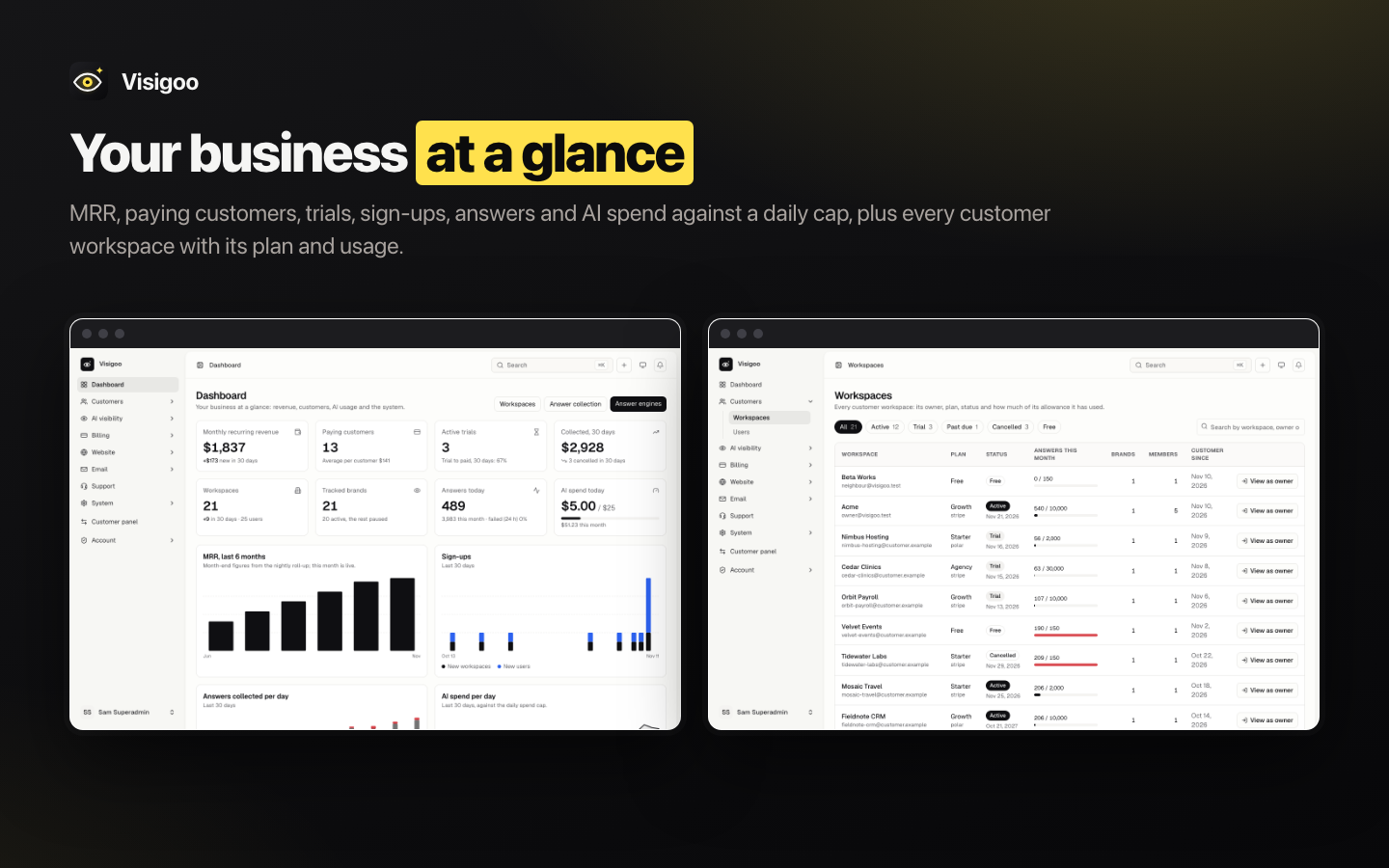
- Admin dashboard: monthly recurring revenue and new MRR, paying customers, average revenue per customer, active trials and trial-to-paid rate, money collected and cancellations, sign-ups, brands, answers and AI spend against the daily cap; charts for MRR over six months, sign-ups, answers per engine per day and spend per day; customers by plan, subscription activity, recent payments, top usage, latest failures and system status.
- Separate admin and customer panels: the operator works only in an admin panel with its own menu (Dashboard, Customers, AI visibility, Billing, Website, Email, Support, System) and sees a workspace exactly as a customer does by impersonating them; customers only ever see their own panel.
- Customers screen: every workspace with owner, plan, status, renewal date, answers used against the allowance, brands and members; filter by status, search, and “View as owner” for support.
- Operator tools: users with impersonation (billing and security actions blocked while impersonating), health checks (environment, cron, queue, database, cache, storage, email, payments, permissions), jobs and failed jobs, log viewer, backups, scheduled tasks, insights and an activity log.
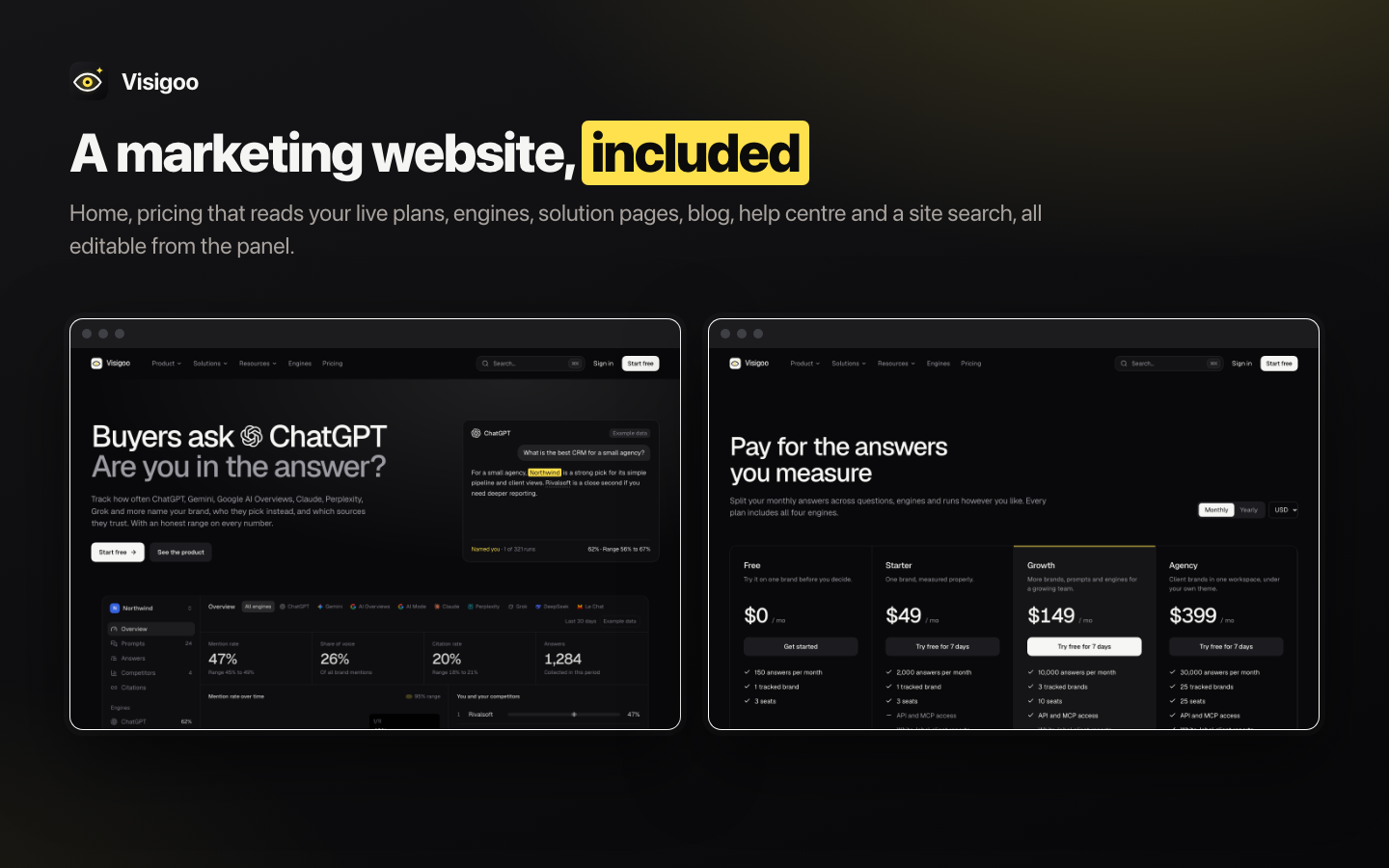
- Marketing website: landing page, pricing that reads your live plans, product, engines, solution pages, methodology, blog and help centre, contact form and newsletter, all edited as blocks with drafts, preview and version history; sitemap, robots, structured data and share cards generated for you.
- Twelve product pages: Visibility, Prompts, Answers, Competitors, Citations, Opportunities, Perception, Shopping, Website, Alerts, Reports and API & MCP each have their own page with its own interactive explainer (a sampling lab, a robots.txt reader, a share-of-voice race, a live MCP chat and more), FAQ and related features, drawn by every site theme in its own way, in all twelve languages.
- Seven site themes: Classic, Answerline, Brandwire, Querygraph, Proofmark, Spotlight and Redline for the public site and its sign-in screens, chosen and previewed in Website → Themes; the admin and customer panels keep their own look.
- Customer stories: a
/customerslibrary and story pages written in the page editor (company, quote, up to three results, engines and features used, challenge, approach and outcome). The three sample stories carry an “Example story” badge. - Site search: a search field in the header opens a quick dialog (⌘K / Ctrl K) across product pages, pages, articles and help.
- Cookie-free site analytics: page views and daily visitors with no cookie and no stored identifier.
- Support desk and help centre: customers ask from the panel; staff answer from Admin → Support, with optional AI reply drafts.
- Email: editable templates for every message, a delivery log, newsletters, and nine email providers with a test button.
- Media library: local disk or eight cloud storage back ends (S3, R2, Spaces, B2, Wasabi, Google Cloud Storage, MinIO, Bunny), with any CDN in front.
- Themes and branding: seven site themes, eleven panel themes, light, dark and system appearance, the site name and colour in settings, and a palette built from a brand colour with contrast checks (Agency plan).
- Languages: English, Turkish, Spanish, German, French, Italian, Japanese, Korean, Chinese, Arabic, Hindi and Indonesian, a language picker in every site theme’s header, right-to-left layouts, a translation editor for every interface string, and any language you add yourself.
- Demo mode: one setting turns an installation into a public demo that refuses changes but lets visitors sign up and go through the checkout in test mode, try every site theme, and resets itself on a schedule.
- Installer and upgrades: a browser installer that writes production settings, a readable message for a wrong PHP version or a missing vendor folder, and an upgrade command that backs up, migrates and clears caches.
- Security defaults: CSRF protection, rate limits, an SSRF guard on every outgoing request, security headers, debug off after install, secrets kept in
.envand never sent to the browser, and an installer that locks itself.
Requirements
- PHP 8.4 or newer with the usual Laravel extensions (the installer checks them and explains each fix)
- MySQL 8 or MariaDB 10.6 (PostgreSQL and SQLite also work)
- One cron entry every minute; a queue worker, or Upstash QStash on shared hosting
- HTTPS for live payments and webhooks
- Your own API key for at least one AI provider, a payment provider account and an email service
Important Notice to Our Valued Customers
We are committed to building a reliable and continuous business system, with your satisfaction and the success of this product as our top priorities. Your feedback is crucial, and we encourage you to share any bugs, suggestions, or new feature ideas. Your input directly supports our ongoing improvement and innovation.
We’re here to help: send us a message anytime through the CodeCanyon messaging system.
Thank you for being part of our journey.
Warm regards,
The Morningstarcode Team
$19 |
Download |
0 average based on 0 ratings.

| Last Update | 2026-11-17 |
| Created | 2026-11-12 |
| Sales | 29 |
| Discussion | Comments |
| Compatible Browsers | IE10 IE11 Firefox Safari Opera Chrome Edge |
| Software Version | PHP 8.x MySQL 8.x |
| High Resolution | Yes |
| Software Framework | Laravel |
| Files Included | JavaScript JS HTML CSS PHP SQL Layered PNG |
| Video Preview Resolution | 1440x900 |


