Heftora | Flutter Task Planner App with Laravel Cloud Backup


Ship a planner that answers the one question a to-do list cannot: does today actually fit. 28 finished screens, every task carrying a time estimate, a day drawn as a wall of bricks against the hours you really have, and a fourteen day horizon you fix by dragging one brick. Light and dark themes, GetX architecture, offline documentation, a Laravel cloud backup, and a one-page product website ready to publish.

Demo Instructions
Three intro screens open the app, then the sign-in screen is a mock that contacts no server and accepts any credentials. Use demo@heftora.app and password demo1234, or simply tap Sign in with both fields left empty. There is nothing to register, no API key to enter and no network connection needed. A worked fortnight of 28 tasks across 3 projects is loaded on first run, and today in it is deliberately over its line, so the screen that makes the argument is the first one you land on.
A day you can see over
Each task is a brick as tall as its estimate, stacked most urgent first. Thirty minutes is 48 pixels, so a day that will not fit is a wall that will not fit, and nobody has to read a percentage to know it. A dashed string line is stretched across at the hours that weekday really holds.

One object, four states
Everything that stands for work is the same shape: a rectangle cut at three pixels, a project color down its left edge, and a six pixel seam of mortar to its neighbour. Planned is outlined, laid is filled with a chalk tick struck across it, a course above the line is hatched, and an overdue one carries a crack rather than a red screen.

Fourteen days of load
Every day is its own small wall at the same scale, with its own line at its own hours. Drag a brick from a heavy day onto a light one and both walls recompute where you dropped it. Work that is already past its day is folded onto today rather than left on a date that has gone.

Estimates that learn from the clock
Start the timer on a brick, or type the minutes in afterwards. The review divides what the work took by what you said it would and prints the number, so the next estimate arrives with a correction beside it. Below five finished tasks it says so in words instead: a factor of exactly 1.0 and “we do not know yet” look identical on a screen and mean the opposite.

The load engine
One file answers every question the screens ask: where each brick sits, which ones stand over the line, what the fortnight looks like, by how much the estimates are out, and what the week came to. It imports nothing from Flutter and takes its clock as a parameter, so a test can assert on an exact minute.

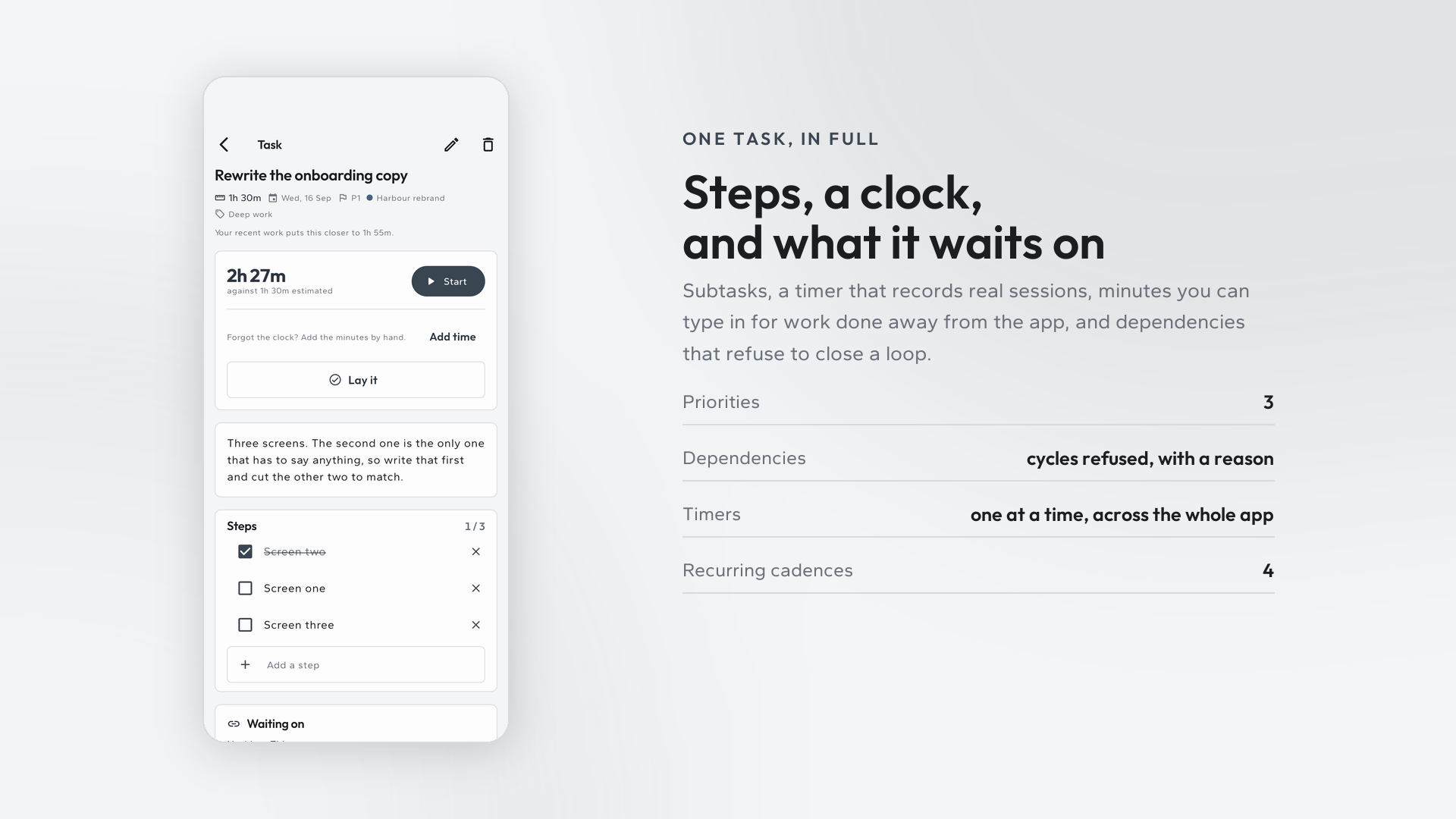
Steps, a clock, and what it waits on
Subtasks, a timer that records real sessions, minutes you can type in for work done away from the app, and dependencies that refuse to close a loop. Three priorities, four recurring cadences, and one timer at a time across the whole app.

What shapes the wall
Working hours per weekday and per single day, projects with their own edge color, labels, standing tasks that clamp to the end of a short month, and a waiting-on view that pairs every blocked task with the thing it is blocked by.


One color file, both themes
Every hue in the app is a token in one Dart file, and the brand color is there in three grades because one value cannot be both a readable button and a thumbnail that stands out on a shelf. Two typefaces ship as four static files, so nothing is fetched at first launch.

Laravel back end included
The download ships a Laravel application with a Filament admin panel (backend/): it stores a backup snapshot per user behind Sanctum tokens, keeps five versions with the oldest pruned, and lets an operator see who is using the space without ever reading the contents. The app runs perfectly well without it — every task lives on the phone and the app makes no network request until a server address is typed into Cloud backup. Deployment needs PHP 8.4 or the included Docker Compose file; hosting is yours.

Landing page included
The download ships a one-page product website for your app (landing/): hero with two phone mock-ups, three feature tiles, a swipeable screen gallery, FAQ and store buttons, already set in the same colors and typefaces as the app and filled with its real screenshots. It is a single self-contained HTML file with no frameworks and no external requests, so you can put it on any static host in a minute and replace the copy and store links from the marked spots.

Built for developers
- Clean GetX architecture: View, Controller, Service, Model, with lazy bindings per route.
- A pure Dart engine you can lift out: the wall layout, the horizon, deferral, the heft factor, the weekly review and the dependency graph live in
data/engine/load_engine.dartwith no Flutter import and the clock injected as a parameter. - Swap in your API without touching a screen: the worked fortnight sits in one file behind a single service; six schema-versioned stores are the only thing that writes.
- Five Dart dependencies: get, http, share_plus, flutter_secure_storage and cupertino_icons.
- Theme-aware components: the same widgets look right in light and dark, and a contrast test measures the painted pixels rather than trusting the theme object.
What you get: full Flutter source code, README with re-theming and API integration guide, offline HTML documentation (28 chapters, 13 screenshots and 2 interaction GIFs), the sample data layer, light and dark themes, the landing page, and the companion back end with its own deployment guide.
Notes
The sign-in and registration screens are interface only and perform no authentication; the app’s records are not protected by them. Local notifications, calendar sync and multi-person sharing are not wired in this version. Figma or Sketch source files are not included; the interface is defined in the Dart source.
All in-app imagery is drawn on canvas or set in type. No third-party photographs are bundled or required, and the two typefaces are included as files under the SIL Open Font License 1.1.
Third-party services and external costs: Heftora runs on bundled sample data out of the box and makes no network request. Connecting it to live services such as Firebase, REST APIs or payment gateways will involve those third-party services, which will incur their own separate costs and are not part of this item. The back end needs PHP 8.4 or Docker and a host of your own.
Changelog
- v1.0 update: the project README now describes this app; the pubspec description is corrected; the cloud backup copy now says what happens (the app sends one JSON snapshot over HTTPS to the server you run); the launcher name is Heftora on both platforms; the Docker MySQL health check waits for a TCP connection, so a first start on a fresh volume no longer races; the documentation’s test count matches the suite (115); a new app icon and splash mark: two leaned bricks on steel blue.
- v1.0: first release.
0 average based on 0 ratings.

| Last Update | 2026-09-29 |
| Created | 2026-09-22 |
| Sales | 0 |
| Discussion | Comments |
| Software Version | Flutter 3.x |
| Files Included | Dart YAML JavaScript JSON .kotlin .swift JavaScript JS CSS PHP HTML |
| Video Preview Resolution |


