Anatomy Blaster | HTML5 Game
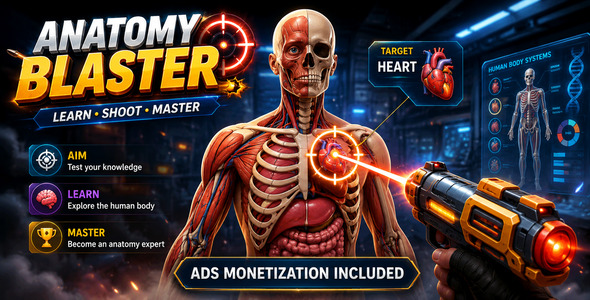

Anatomy Blaster – HTML5 Human Body Identification Shooting Game
Anatomy Blaster is a fast-paced human body identification shooting game built entirely with HTML5 Canvas, CSS3, and Vanilla JavaScript. Anatomy term icons fall from the top of the screen like enemies. The player types the correct anatomy term to identify it — the spaceship locks on and shoots it down. Miss one and it costs you health. When health reaches zero, the game is over.
It is designed for schools, medical students, or anyone looking for a fun and interactive way to learn the human body. No Node.js, no PHP, no database — just upload the folder to any web host and it works immediately.
Zero Setup Required: Double-click index.html to play locally, or upload to any hosting provider and it is live instantly. No installation, no build process, no dependencies.
Key Stats
- 69 Anatomy Terms
- 4 Difficulty Levels (Easy, Medium, Hard, Insane)
- 5 Enemy Types
- 6 Power-Ups
- 5 Icon Display Modes
- Endless Wave System
Features
- Endless Wave System — Waves progress indefinitely, getting harder every round. No level cap.
- Auto-Targeting Laser — A cyan laser pointer automatically locks onto the next enemy so the player always knows which term to type.
- 5 Enemy Types — Normal, Fast, Zigzag, Stealth, and Boss enemies, each with unique movement behavior.
- 6 Power-Ups — Shield, Slow Time, 2× Score, Clear All (Bomb), Heal, and Freeze. Drop randomly during gameplay.
- 69 Anatomy Terms — Full database covering organs, skeletal, muscular, sensory, body systems, and cellular structures — split across 4 difficulty pools.
- Leaderboard — Tracks top 20 high scores locally. Players compete against their own best runs.
- Save & Continue — Players can save progress and resume from any wave on their last run.
- Hint System — 3 hints per wave reveal the first letter and total word length. Each hint costs 5 HP.
- Revive System — Up to 3 revives per run, each restoring 50 HP. Can be free or gated behind a rewarded ad.
- SPM Tracker — Measures the player’s Solutions Per Minute, a real-time speed indicator that adds a competitive layer.
- Full Mobile On-Screen Keyboard — Custom keyboard built for touch devices covering all letters needed in anatomy term names.
- Advertisement Support — Built-in ad system for banner and interstitial ads. Paste your AdSense or any ad code into a single config file.
- 5 Icon Modes — Emoji, OpenMoji, Iconify, Custom Images, or Mixed mode. Switch with one line in the config file.
- Custom Term Sets — Restrict the game to specific anatomy pools. Perfect for classroom quizzes focused on a specific lesson chapter.
- Medical Visual Theme — Deep operating-theater design with bioluminescent cyan glow and dark surgical aesthetics.
- Flexible Answer Validation — Case-insensitive. Accepts alternate names and Latin medical terms so players are not penalized for valid variations.
- Progressive Difficulty Mixing — Harder terms gradually mix into lower difficulty waves over time, keeping the game fresh.
- Boss Enemies — On Insane difficulty, a Boss term appears with 3 HP and must be identified three times to destroy. Awards 3× score.
Technologies Used
Anatomy Blaster is built using only core web technologies — no frameworks, no libraries, no build tools. Everything runs directly in the browser.
- HTML5 — Game structure, Canvas element, UI screens, menus, and overlays.
- HTML5 Canvas API — Real-time rendering of the spaceship, enemies, bullets, particles, laser pointer, and all game animations.
- CSS3 — Medical dark theme, animations (loading, power-ups, transitions), responsive layout, and on-screen keyboard styling.
- JavaScript (Vanilla ES6) — Full game engine — wave manager, enemy AI, typing system, scoring, leaderboard, ad system, settings, hint and revive logic.
- Web Storage API — LocalStorage used for saving high scores, player settings, and wave progress.
- Web Audio API — Sound effects and in-game audio engine, synthesized entirely in JavaScript.
No external JavaScript libraries used. No jQuery, no React, no bundler. Optional CDN resources (OpenMoji, Iconify) are used only for icons and can be switched off with the offline emoji mode.
Browser Support
Anatomy Blaster runs in all modern web browsers using standard HTML5 Canvas and Web APIs supported across all major platforms.
- Google Chrome — v88 and above — Full Support
- Mozilla Firefox — v85 and above — Full Support
- Microsoft Edge — v88 and above — Full Support
- Apple Safari — v14 and above — Full Support
- Opera — v74 and above — Full Support
- Samsung Internet — v13 and above — Full Support
- Chrome for Android — All modern versions — Full Support
- Safari on iOS (iPhone & iPad) — Full Support
- Firefox for Android — Full Support
Platform Compatibility: Windows, macOS, Linux, Android, iOS, and Chromebook are all fully supported.
The game is fully mobile responsive. It includes a custom full on-screen keyboard for touch devices and adapts to all screen sizes — phones, tablets, and desktops.
What’s Included
- The complete game — ready to upload and play immediately.
- All CSS files for styling, animations, responsive layout, and theming.
- Full JavaScript game engine covering all gameplay systems.
- Simple config files for ads, icon modes, and custom anatomy term sets.
- Complete anatomy terms database with icons, names, difficulty levels, and alternate names.
- Full documentation and setup guide included in the package.
All customization — colors, anatomy terms, difficulty, ads, icons — is done through simple config files. No need to touch the core game engine files.
Who Is It For
- Schools & Classrooms — Teachers can configure custom anatomy term pools to match specific lesson chapters, turning the game into a focused quiz tool for students.
- Medical Students — A fun and fast way to memorize anatomy terminology — Latin names, alternate medical terms, and body systems — under exam-style pressure.
- Game Publishers — Ready-to-deploy educational game with ad monetization built in. Upload it to your domain, paste your ad code, and start earning.
- Developers — Clean, well-commented, modular codebase. Easy to reskin into any subject by swapping the term database.
0 average based on 0 ratings.


